
Akasat Patitam Toyam
सर्वदेव नमस्कारः केशवं प्रतिगच्छति ॥
sarvadeva namaskāraḥ keśavaṃ pratigacchati ..
आकाशात् (ākāśāt) – from the sky/space
पतितं (patitaṃ) – fallen/dropped
तोयं (toyaṃ) – water
यथा (yathā) – just as
गच्छति (gacchati) – goes/reaches
सागरम् (sāgaram) – to the ocean
सर्व (sarva) – all
देव (deva) – gods/deities
नमस्कारः (namaskāraḥ) – salutations/bowing
केशवं (keśavaṃ) – to Keshava/Krishna/Vishnu
प्रतिगच्छति (pratigacchati) – reaches/goes toward
Description
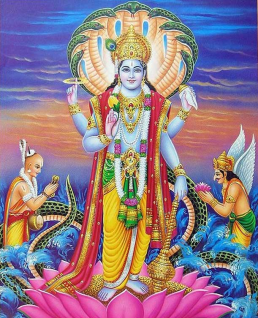
This verse expresses the fundamental Vedantic principle that despite apparent multiplicity, there is ultimately one underlying reality. All forms of worship, regardless of the deity invoked, ultimately reach the same Supreme Reality (Brahman/Vishnu/Ishwara/Paramatma). This supports the concept that different deities are manifestations of one Reality.
The verse also embodies the classical Hindu theological position of Ishta-devata (chosen deity) within Advaita (non-dualism).
This principle is directly supported by Krishna’s teachings in the Bhagavad Gita:
Chapter 7, Verse 21:
यो यो यां यां तनुं भक्तः श्रद्धयाऽर्चितुमिच्छति।
तस्य तस्याचलां श्रद्धां तामेव विदधाम्यहम्॥
“Whatever form a devotee with faith desires to worship, I make that very faith of his steady.”
And in the following verse:
Chapter 7, Verse 22:
स तया श्रद्धया युक्तस्तस्याराधनमीहते।
लभते च ततः कामान्मयैव विहितान्हि तान्॥
“Endowed with that faith, he seeks to propitiate that deity and obtains his desires. But it is I alone who bestow them.”
Chapter 9, Verse 23:
येऽप्यन्यदेवताभक्ता यजन्ते श्रद्धयान्विताः।
तेऽपि मामेव कौन्तेय यजन्त्यविधिपूर्वकम्॥
“Even those who worship other deities with faith, they too worship Me alone, O Arjuna, though not according to the prescribed method.”
These verses demonstrate that Krishna, as the embodiment of the Supreme Reality, receives all acts of devotion irrespective of their source or which deity is being worshipped – a teaching that finds perfect expression in the water-ocean analogy of the above verse, where all water naturally flows to its source regardless of where it initially falls.
Note: This quote is included within the Mahāsubhāṣitasaṃgraha (महासुभाषितसंग्रह, maha-subhashita-samgraha / subhasita-sangraha), which is a compendium of Sanskrit aphorisms (subhāṣita), collected from various sources. Subhāṣita is a genre of Sanskrit literature, exposing the vast and rich cultural heritage of ancient India.
Other Vishnu Shlokams
Acyutam Kesavam
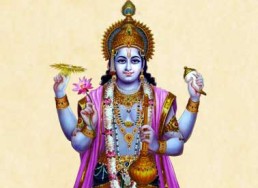
Everybody should meditate regularly upon Achyuta, Kesava, Vishnu, Hari, Satya, Janardhana and Narayana, the swan, which signifies the quintessence of things.
Apavitra Pavitro
Om, if one is Apavitra (Impure) or Pavitra (Pure), or even in all other conditions, he who remembers Pundarikaksha (another name of Sri Vishnu, literally meaning with lotus-like eyes), he becomes pure
Bhaja Govindam
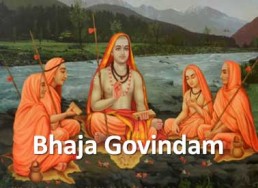
Bhaja Govindam is one of the most popular hymns penned by Adi Shankaracharya. He has packed into the Bhaja Govindam song the substance of all Vedanta, and set the oneness of Jnana and Bhakti to melodious music.
Bhaja Govindam All Verses
Bhaja Govindam (Praise Govinda/Repeat the name of Govinda), is one of the most popular hymns penned by Shankara, that is still sung and recited by millions of Hindus every day.
Bhaja Govindam Popular
Note: This is the popular version sung by Smt. M.S. Subbalakshmi. It does not include all the 31 verses. Bhaja Govindam MS Subbalakshmi version with meaning, lyrics, audio, sanskrit, multiple languages and significance.
Dhanvantari Mantra
The Dhanvantari Mantra calls upon the divine healer, Lord Dhanvantari, the god of Ayurveda, for health and protection from ailments.
Kayena Vaca
Whatever I do either by body, speech, mind or sensory organs, either with my personal knowledge or natural trait, I surrender and submit all to that to supreme divine Narayana.
Lakshmi Narasimha Karavalambam
Narasimha is a fierce avatar of the Hindu god Vishnu, one who incarnates in the form of part lion and part man to destroy evil and end religious persecution and calamity on Earth, thereby restoring Dh
Mantra Pushpam
The Mantra Pushpam (literally translating to "Flower of Mantras") is a collection of sacred verses from the 10th chapter of Taittiriya Aranyaka of Krishna Yajur Veda. Each verse begins with an exploration of the relationship between the flower of…
Megha Syamam
Salutations to Sri Vishnu who is beautiful like the dark clouds, and who is wearing yellow garments of silk; Who has the mark of Srivatsa on his chest; and whose body is shining with the radiance of t
Namami Narayana Pada
I salute the lotus-feet of Narayana, always, propitiate Narayana, speak of the pure name of Narayana and bear in mind the immutable factuality of Narayana.
Narayana Kavacham
The Narayana Kavacham occurs in chapter eight of the sixth skanda of Bhagavada Purana. It is an Armour (Kavach) to protect ourselves from all our enemies (including negativitie
Narayanam Hrishikesam
I salute Narayana, Hrishikesa, Govinda, Garudadhwaja, Vaasudeva, Hari, Krishna and Kesava.
Narayaneti Vagvalvi
The four letters 'Na', 'Ra,'Ya', 'Na' are the four shoots on the creeper of speech and are undoubtedly indicative of the four Purusharthas- Dharma, Artha, Kaama and Moksha.
Ranganatha Ashtakam
Ranganatha Ashtakam was written by Adi Sankara Bhagavatpada when he stood before Sri Ranganatha swamy in Srirangam, during his travels. This Ashtakam reveals that Adi Sankara was overwhelmed by Lord R
Sashanka Chakram Sakirita
I salute, prostrate with my head, to that four-armed Lord Vishnu, who is ornamented with the shankh (conch) and chakra (the divine wheel), the crown and ear-drops, yellow silk robes, lotus-eyes, decor
Shantakaram
We bow to the only lord of all worlds, Vishnu who is of peaceful appearance, reclining on the serpent, with a lotus from the navel, lord of gods, the basis of the universe, vast like the sky, coloured
Somanatha Vaidyanatha
One who remembers Somanātha (Lord Śiva), Vaidyanātha (the healer Śiva), Dhanvantari (the divine physician), and the twin Ashvinis (divine doctors of the gods) every morning will not be touched by dise
Swayam Vyakta Sthalam
First, called "Ranga", the great temple (of Srirangam), made known by the (great lord) Ranga, (Then) Srimushanam and Venkatadri, Salagrama and Naimisha, Toyadri (Thiruneermalai), Pushkara and indeed N
Venkatesa Suprabhatam
This shlokam is taken from Sri Valmiki's Srimadh Ramayanam. During the journey with Sage Viswamitra, both Rama and Lakshmana had rested for the night on the banks of the Ganga river. As the dawn was
Vishnu Sahasranamam
The Vishnu Sahasranam is found in the Mahabharatha. Literally translated this means thousand names of Vishnu. This is found in the Anushasanika Parvam (chapter relating to orders or rules to the kings) of Mahabharatha. Though it describes one…
Vishnu Shatanama Stotram
The Vishnu Shatanama Stotram is a revered hymn that encapsulates the divine attributes and various forms of Lord Vishnu, serving as a powerful invocation for devotees seeking spiritual elevation and liberation. The stotra, composed by Sri Veda…
Vishnu Shatpadi Stotram
The Sri Vishnu Shatpadi is a revered Sanskrit stotra (hymn) dedicated to Lord Vishnu, the preserver and protector in Hinduism. Composed by the illustrious philosopher and saint, Sri Shankaracharya, this hymn comprises six verses (ṣaṭpadī) that…
Akasat Patitam Toyam – Vishnu – In Sanskrit with English Transliteration, Translation and Meaning. Commentary for selected Shlokams.