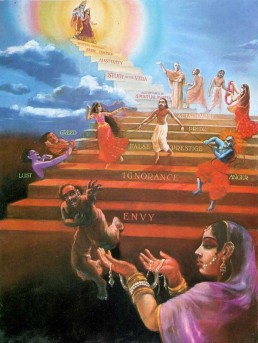
The relationship between spirit and matter which is the source of creation is explained here. The vedantic technical terms for these words are `Purusha’ for the indwelling spirit and `Prakriti’ for the matter. Matter is inert, insentient while spirit is sentient, dynamic. A combination of these two ingredients causes things to be born and function. In a steam engine, steam is the spirit-factor which makes the iron and steel assemblage of the engine which are matter-envelopments to function. The iron and steel components which are manufactured by somebody cannot function by themselves unless steam is made to pass through them. When the steam passes through the iron and steel assemblage we say that a steam engine is born or created.
CREATION
Let us understand the process of creation from the Vedantic angle in more details.
‘First before understanding the topic of creation, we should clearly know that the very word creation is a misnomer because nothing can be created on account of the law of conservation of matter and energy. Then if at all we use the word Creation, it only refers to the manifestation of something which was potentially, un-manifestly existent. So only that which is un-manifestly, potentially existent in dormant form can come to manifestation.
MANIFEST VS UNMANIFEST
What is meant by the words manifest and unmanifest? By the word unmanifest, we mean Pramanam Agocharam. Unmanifest is that which is existent but is not available for perception or transaction like the butter in the milk. Butter is there in the milk, but we cannot see it in the milk. But we know that milk has butter. So what can we say about butter being existent or not? It is existent technically but for all practical purposes, since it is neither available for perception nor available for transaction we assume that butter is non-existent. But we know butter is there.
We can extend this analogy to everything in the creation. Nothing in the creation is non existent. It was existent in potential manner. Later it becomes manifest, which means it is available for transaction. Our scriptures point out, before the origination of this cosmos, it should have existed because of this simple law of conservation. And if this creation existed before, it should have existed in un-differentiated and unmanifest form or potential form or dormant form which we can call as the seed of the creation. In Sanskrit we use the word B_jam for this or Causal form of matter.
Matter in its causal form is the source of all forms of energy and all forms of matter. The causal matter is called Maya. This means that before the creation originated, one thing was there which is called Maya.
We have to include one more thing that existed before creation. That is Atma which is the consciousness principle, the non-material spirit. It does not come under matter and therefore it does not come within time and space. This means that as consciousness is beyond time and space it has to be eternal which implies that before the creation, consciousness also existed.
So now we had arrived at two things that were existing before creation –
Principle 1: Consciousness which is called Atma which is unconditioned, un- influenced, un-circumscribed by the time and space.
Principle 2: Whole creation in causal matter form called Maya
To put it in simple words, we can now conclude that Consciousness and Maya existed in causal form before creation.
In the context of cosmology or creation, consciousness is given another name. At the Micro level i.e., with reference to an individual, consciousness is given the name of Atma. The very same consciousness at the Macro level is called Brahman. Therefore Atma and Brahman are synonymous meaning the same thing i.e., consciousness.
Atma means Apnoti Sarvam Iti Atma ‘ the boundless all pervading one. The word Brahman means infinite derived from the root Bruh ‘ to be big ‘ therefore Brahman means the Big One, the Absolutely Big One.
Thus the study of cosmology begins with two beginning-less principles known as Brahman and Maya or Consciousness (Spirit) + Matter.
DIFFERENCE BETWEEN MAYA AND BRAHMAN
The common features of Brahman and Maya are both have no beginning, no origin. But differences are several as given in the Table below.
BRAHMAN & MAYA
Sr. No.
Brahman
Maya
1
Non-material Principle called Consciousness.
Material principle.
2
Does not have physical properties. It is called Nirguna, propertyless principle because it is non-material in nature.
It is full of potential properties because it is matter. Hence it is called saguna.
3
It is beyond Time & Space. It is never subject to change. It is changeless.
Because it is matter principle, it can never remain the same.
4
It is nirvikalpa, not subject to spatial division. Consciousness is one and not many. It is divisionless.
Maya, the material, is subject to multiplication and division.
These are the basic similarities and differences between Brahman and Maya and out of their blending alone this universe comes into manifestation for our recognition like we churn and bring out the butter which is then available tangibly for our transaction.
STAGES OF MANIFESTATION
In the scriptures the evolution or manifestation of the cosmos is presented in two stages. Like a seed becoming a plant in the middle stage, and then the plant becoming a full fledged tree in the final stage.
Therefore Maya is a seed stage containing the causal universe which comes to the level of subtle universe comparable to that of a plant and then the subtle universe evolves or manifests to become the gross universe fully available for all forms of transactions and engagement.
If you have to understand the difference between the subtle and gross creation you can compare your body and mind. Mind is also a creation or manifestation. Body is also a manifestation. But mind is a subtle manifestation not available for a physical vision because it is not tangible. But the body is gross visible to the eye.
SUBTLE AND GROSS ELEMENTS
The scriptures point out that first, out of the causal universe five subtle elements is born. These are called Pancha Bhuta. These are 1.Akasa or space 2.Vayu or air
3.Agni or fire 4.Jalam or water 5.Bhumi or Prithvi: the earth. In the initial stages, they are in subtle form, which means they are not available for our transaction. They are not even visible.
M_y_ is defined as Tri Gunatmika i.e.endowed with threefold feature which is seen in the universe. They are Sattva Guna , Rajo Guna and Tamo Guna . These three Gunas or features or attributes inhere the five elements also. Thus we have got S_ttvika component of space, R_jasik a component of space and T_masik component of space. Similarly we have S_ttvika component of air, R_jasik component of air and T_masik component of air. Same applies for Fire, Water and Earth. Therefore we have fifteen items. Hence the first form of creation is S_kshma Bh_ta Srushti ‘ the creation or manifestation of the subtle elements.
STAGE 1 ‘ SATTVA GUNA AS GENERATOR:
From the Satvic portion of subtle elements are born the organs of perception (jnana indriyas), Ear is born from the Satvic aspect of Space, Skin from Air, Eye from fire, Tongue from water and Nose from earth.
From the total Satvic content of the five elements are born the Anthahkarana or inner instrument. Antahkarana consists of four aspects, manas, Mind (doubting nature), buddhi, intellect (deciding nature), ahankar, ego (“I am the doer” nature) and chitta, memory (thinking faculty)
STAGE 2 ‘ RAJO GUNA AS GENERATOR
From the Rajasic portion of subtle elements are born the organs of action (karma indriyas). From the rajasic aspect of space is born the speech, hands from air, legs from fire, genitals from water and anus from earth.
From the total Rajasic content of the five elements are born the five vital airs or
pancha prana..
Each of the subtle elements is endowed with the property of its own. Space (akasa) has the property of producing sound; air (vayu) of producing touch; fire (agni) of visibility; water (ap) of flavor; and earth (bhumi) producing smell (sabda, sparsa, rupa, rasa, gandha). These are the five ways in which a man, through his five sense organs becomes aware of the prakriti or matter. Hence Hindu philosophers have divided matter into five elements. It is to be noted that mind or manas (the inner organ that creates doubt), intellect or buddhi (the inner organ that decides) and I- Consciousness or Ego belong to the realm of prakriti or matter.
The entire S_kshma Shariram is born out of Sattva Guna and Rajo Guna of the five subtle elements. Therefore we have seen Sukshma Bhuta Srushti and Sukshma Sharira Srushti ‘ in short the entire subtle universe.
STAGE 3 ‘TAMO GUNA AS GENERATOR
From the Tamasic portion of the subtle elements are born the gross elements. The gross elements are formed through combination of tamasic portion of subtle elements in which each of the subtle elements combines with the remaining four subtle elements under a peculiar formula to produce a gross element. This process of combination is called panchikaranam.
Thus the gross elements of ether, air, fire, water and earth are produced which we are able to see with our eyes. The five subtle elements are therefore the causes for the five gross elements. The scriptures point out that the Tamas components of the five elements alone get grossified to become the five gross elements ‘ Pancha Sthula Bhuta.
The scriptures say that until grossification, each element was isolated and pure. One element was not adulterated or mixed with others. But when grossification takes place, the Tamo Guna of these five elements gets intermixed. This is just like eating a salad. Sukshma Prapancha is like eating grapes separately, bananas separately etc. Grossification means eating all together. Once we come to five grossified elements, each element has got a mixture of all the five. So Earth has got five elements, space has got five elements. Same way for Air, Fire and Water. This process of ‘salad making’ is called Panchi Karanam or Grossification.
Once the five gross elements are born, out of that the entire cosmos including all our physical bodies are created. This is called Sthula Srushti or Sthula Abhivyakti.
Thus Maya is causal universe. And out of that comes subtle universe called Sukshma Abhivyakti. And out of that comes gross universe which is called Sthula Abhivyakti. Thus the entire creation comes out.
Therefore causal universe to subtle universe to Gross universe. This is the creation. Of these, the causal universe is beginning-less, but the subtle and gross have a beginning and an end.
Once it has become fully gross and moved about for some time, what happens to the whole creation? Again it collapses, condenses or contracts; evolution will later end up in involution or dissolution. The gross becomes subtle and subtle again becomes gross. Thus unmanifest to manifest and manifest to Unmanifest, the universe undergoes this cycle always. But the Universe will always be there. The difference is
only a question of degree but not substance. There is no increase or decrease in matter but there is only change in its condition or state ‘ manifest condition to unmanifest condition and unmanifest to manifest.
Avyaktadini Bhuaani Vyaktamadhyani Bharata Avyakta Nidhananyeva Tatra Ka Paridevana
Krishna will tell us in the Bhagavad Gita later ‘ why are you talking about death? Death is nothing but body going out of shape. Nothing is lost, Arjuna, but for whom are you crying? The problem is that we have got attached to shape and lost sight of the substance.
The creation will last for some time and again collapse to Maya. What will be Brahman doing? Consciousness remains. When the appropriate conditions come forth, it manifests in the form of life. When the manifesting conditions are not there, consciousness remains unmanifest. This is Vedic Cosmology’. (Adopted from Swami Paramarthananda’s Discourses on ‘ Tattva Bhodha’ )
Let us turn back to the Gita.
Once the individual understands the distinction between matter and spirit, he will know that the cause of all our sufferings is due to spirit identifying with matter. When spirit is detached from all its identifications, it rediscovers for itself its own essential nature as Perfection and Bliss Absolute. The spirit identifying with matter or apara prakriti is called ego. This is also called super imposition on the Truth through ignorance. It is apara prakriti which is the cause of the world and by which the ego or Jiva gets bound. It is the ego that rediscovers itself to be nothing other than the spirit or para prakriti that presides over the matter. In order to make it clear Sri Krishna tells that the matter-aspect is distinct from the spirit-aspect in each individual.
The five elements are represented by the sense-organs by which the individual lives and gathers experiences in the world of sense objects as we have seen above. The sense organs are the channels through which the world of stimuli reaches the mind. The impulses received in the mind are classified and systematized as knowledge by the intellect. During all these assimilation the ego falsely identifies the body with the Spirit and the sense of `I’ or `My’ is produced.
Sri Krishna says that the equipments referred to in Verse 4 are not all that the Self possesses. The Self has, besides them, equipments of a higher nature which are Pure Consciousness or Awareness i.e., para prakriti (Verse 5). It is this spiritual aspect in everybody that makes it possible for the body, mind and intellect which are inert matters to function as if they are very cognizant and intelligent.
The spiritual factor is the entity with whose contact the body equipment works and without which it becomes dull and insentient. Without this spiritual spark man will be no more than a stone and he will not be able to experience the world outside or within him. The world of objects, the world of feelings and the world of ideas that we experience constitute in their totality the Jagat or universe which is supported by the principle of consciousness.