Commentary
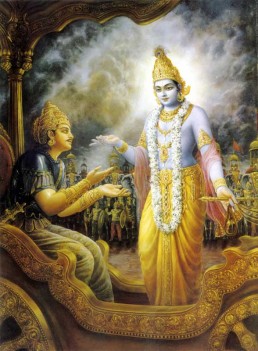
Arjuna misunderstands the teaching that work for reward is less excellent than work without attachment and desire and believes that Sri Krishna is of the view that knowledge without action is better than work. If Sankhya method of gaining wisdom is superior, then action is an irrelevance. In this confusion he asks Sri Krishna as to which of the paths he has to follow for his self-development since he still believed that to fight against his people was a terrible action. Hence, Arjuna requests Sri Krishna to teach him for certain either of the two ‘ knowledge or action – in accordance with the state and power of his understanding by which he could attain the highest good i.e. complete eradication of grief and infatuation and attainment of that imperishable.
The confusion is only seeming. It is not the intention of the Lord to confuse Arjuna but yet Arjuna is confused.
LIFE IS WORK BUT THE NEED IS UNCONCERN FOR RESULTS
Swami Chinmayananda
Swami Chinmayananda Commentary
The commentary on this verse and the rest, is avaialble for free as:
Kindle eBook
Google Play Book
Apple Books
Adi Sankara Commentary
‘Though the Lord speaks lucidly, still, to me who am of a dull understanding, the Lord’s utterance appears to be conflicting’. Mohayasi, You bewilder; me, any; buddhim, understanding; iva, as it were; vyamisrena iva, by that seemingly conflicting; vakyena, statement! You have surely undertaken to dispel the confusion of my understanding; but why do You bewildered (it)? Hence I say, “You bewildered my understanding, as it were.”‘
However, if You [In some readings, ‘tvam tu, however, you’, is substituted by ‘tatra, as to that’.-Tr.] think that it is impossible for a single person to pursue both Knowledge and action, which can be undertaken (only) by different persons then, that being the case, vada, tell me; niscitya, for certain; tadekam, one of these, either Knowledge or action: “This indeed is fit for Arjuna, according to his understanding, strength and situation”; yena, by which, by one of either Knowledge or action; aham, I; apnuyam, may attain; sreyah, the highest Good.’
Even if Knowledge had been spoken of at all by the Lord as being subsidiary to steadfastness in action, how then could there be the desire in Arjuna to know of only one of them, as expressed in ‘Tell me one of these two?’ Certainly the Lord did not say, ‘I shall speak of only one among Knowledge and action, but surely not of both’, owing to which, Arjuna, considering it impossible for himself to acquire both, should have prayed for one only!
The answer was in accordance witht the question:

The Bhagavad Gita with the commentary of Sri Sankaracharya – Translated by Alladi Mahadeva Sastry
Holy Geeta – Commentary by Swami Chinmayananda
The Bhagavad Gita by Eknath Easwaran – Best selling translation of the Bhagavad Gita
The Bhagavad Gita – Translation and Commentary by Swami Sivananda
Bhagavad Gita – Translation and Commentary by Bhaktivedanta Swami Prabupadha
Srimad Bhagavad Gita Chapter 3 – Verse 2 – 3.2 vyamishreneva vakyena – All Bhagavad Gita (Geeta) Verses in Sanskrit, English, Transliteration, Word Meaning, Translation, Audio, Shankara Bhashya, Adi Sankaracharya Commentary and Links to Videos by Swami Chinmayananda and others – 2-Mar