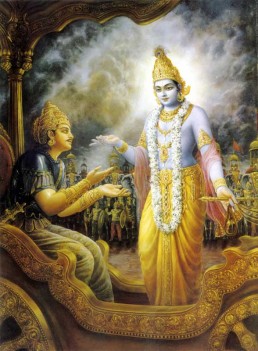
If The Lord does not work it will not be conducive to the progress of the Universe. The Universe is not chaos but a cosmos. Nowhere chaotic conditions are observed in the working of the cosmic forces. Movement of planets, occurring of seasons, laws of the oceans, various social orders and disiplines etc., always obey the law of nature or God.
The Lord represents not only the law governing the outer world of things but also the law that governs the inner world of thoughts and emotions. Human society is divided into four castes on the basis of individual mental temperaments. In case the law governing the inner temperaments does not function there will be confusion in behavior and instability in the character of people bringing about their own destruction.
Concepts and Issues
Arjuna is confused about the relative importance of knowledge and work. If the man of knowledge is superior to the man of action, then why is he being asked to pursue the path of action and undertake such a terrible act like a fratricidal war?
Sri Krishna replies that there are two types of people viz. the purely intellectual and the physically active. The path of knowledge is prescribed for the intellectual, whereas the path of action is the best for the physically dynamic. But it should be born in mind that dedicated action by itself cannot be the end. It is only the means to achieve the final goal of Realization of the Self. On the other hand, the path of wisdom takes one directly to the final goal.
The path of knowledge is not the proper one for Arjuna as he, being a Kshatriya, does not belong to the meditative and intellectual type. His natural aptitude is for action and he can purify himself only through action. So he has to discharge his duties in a selfless spirit of pure devotion without expecting any fruits of such action.. If one understands the art of performance of actions without selfishness, one is already in the path of knowledge as these two paths are not contradictory but complementary.
An action performed without any concern for the fruits thereof is not inaction because such action never produces any psychological reaction and gains wonderful results while inaction i.e. running away from action, produces nothing but idleness.
All beings always remain active. Inaction is against the law of nature. Inaction by external withdrawal of sense organs from the sense objects while the mind remaining preoccupied with the thinking about those objects is hypocrisy or escapism and self deception. A real seeker of wisdom is the one, who conquers his organs of perception by his mind but employs his organs of action in the selfless discharge of his duty. Performance of one’s duty is, in all respects, preferable to utter inaction. One cannot live even the everyday ordinary life without doing anything.
Only those actions which are prompted by desires entail bondages of vasanas but not those performed in the discharge of one’s duty with no expectation of the result and meant only as an offering at the feet of The Lord. It is called performing of actions in the spirit of Yagna i.e. sacrificing our selfish interests for the welfare of the humanity at large. Here the word Yagna which means Vedic ritualism includes all self-less co- operative activities.
In the beginning the Creator created all living beings with a capacity of yagna in everybody i.e. to work with a selfless attitude, in a spirit of dedication for the common welfare. The spirit of co-operation between the high and the low, the rich and the poor, the wise and the dull, the spirit of give and take and many more such noble and divine values of harmonious living in society are meant by the word Yagna. He only commits stealing who is only ready to take but not to give. People used to propitiate God by sacrifice who in turn bestowed them with plenty and prosperity through rains, fertility of the soil to yield nourishing food.
Mother Nature provides many examples of the spirit of constant sacrifice like the Sun giving light, the Earth satisfying all human requirements and the Fire giving heat etc. Thus sacrifice is an unselfish action. Prosperity and plenty are the direct results of such dedicated actions.
The capacity to do well in us has been given by the Creator, the Supreme, manifested through its own creative urge. What we are bound to do in our station in life we must do well for our own good and for the good of the entire community. Wherever such a noble work is undertaken in a spirit of co-operation (Yagna) there is God, the Highest. Those who have reached the highest state of eternal contentment need not pursue this path because they have nothing to gain by actions as the individuality in them created by ego has already ended and they do not depend upon anyone for anything.
Sri Krishna advises Arjuna that he still being a seeker of Knowledge should discharge his duty in a spirit of dedication as an offering to The Lord citing examples of King Janaka and others of Perfect Wisdom who attained Perfection through selfless discharge of their duties. The Lord gives His own example of engaging Himself in activities continuously although it is immaterial for Him whether He acts or not.
The reason for this is that the common people with limited intelligence imitate the great and so if The Lord has to remain inactive, they will also remain idle leading to indiscipline
Live as the Gita Teaches You to Live
Action one must perform; but it should be performed in the spirit of Yajna. The aim is Lokasangraha, the benefit at large.
Interdependence of beings in the cosmos should not be forgotten. He who works for himself alone lives in vain.
Leadership qualities are stressed. Set an example to others in right living.
Points to Ponder
What was Arjuna’s doubt in the beginning of the Chapter and what was Sri Krishna’s clarification to it?
How does a man bound by action?
Who is a hypocrite?
What is the philosophy of action?
How can one be free from action?
What is the cosmic wheel of co-operation?
What is meant by Lokasangraha?
What is the difference between the activities of the wise and the ignorant?
Why it is important for the wise man to set an example to others in rightful living?