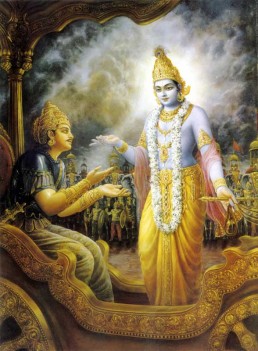
Earlier it was explained how ignorance leads to desires, desires to thoughts and how thoughts in conjunction with mental tendencies i.e. Gunas viz. Sattwa, Rajas and Tamas- manifest themselves in the outer world as actions of different qualities. Nobler the thought, nobler the action and meaner the thought, meaner the action and so on.
Thus the Gunas modify themselves into the outside world, the body and the senses which are called the modes of Prakriti. They are classified into twenty three categories viz. intellect, ego, mind, the five subtle elements of ether etc., the ten organs of perception and action, and the five objects of senses viz. sound, touch, sight, taste and smell. These are the performers of all action. The word ‘action’ includes all the functions of the organs of perception and action (jnana indriyas and karma indriyas). The self looks on without participating in any way in the action done by the body and the senses. Whatever actions take place in this world are nothing but the operations of the aforesaid modes of Prakriti and the absolute and formless Atma or the Self has really nothing to do with them.
An ignorant man, however, identifies the Self with the aggregate of the body and the senses and calls it as ‘I ‘and thinks that the Self is the doer.
Even though the Self or the soul has no relation with actions, the unwise man identifying himself with the body and the senses associates himself with the different actions of the body and thus assumes himself to be the doer of those actions. In other words he thinks it is he who resolves, he who reflects, he who hears, he who sees, he who eats, he who drinks, sleeps, walks and so on and thus traces every action to himself. Thus he ascribes to the Self all the characteristics that really belong to the Gunas. That is why action becomes the cause of bondage to him. It is the reason for him to go through the process of repeated births and deaths to reap the fruits of those actions
BUT THE ENLIGHTENED MAN FEELS DIFFERENTLY