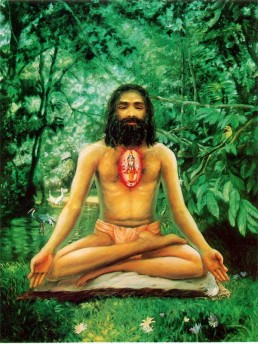
In these two verses the Lord describes the benefits of Yoga. During meditation when the mind is withdrawn from the world of objects and is concentrated on the Self, it acquires quietitude and the thought flow ceases. Where there is no thought flow there is no mind.
Where the mind has ended, there the seeker experiences the Infinite nature of the Self and the meditator reaches to the Supreme Bliss by ending all his mental agitations.
The ego discovers that it is none other than the Self and hence there is no dualism at this stage. Such a man of self-realization himself becomes Brahman. The meditator (Upasaka) becomes one with the object of meditation (Upasya).
A meditator step by step grows out of his own ignorance and imperfection represented by his ego and merges with the Supreme. He loses contact with the objects of the senses and comes into contact with the Self within – Brahman. This means that the seeker becomes Brahman and comes to experience the Infinite Bliss as against contact with the world of objects (`not-Self’) whose joys are always finite. He becomes a Jivanmukta, liberated while living in a body.
Chandogya Upanishad (VII-xxiii.I) says ‘That which is infinite or great beyond all, is true happiness. There is no joy in that which is finite. Happiness lies in infinity. Efforts should be made in particular to know the Infinite alone’. It continues ‘The Infinite represents that plane of consciousness in which no other is cognized and the state in which another is seen, another is heard and another is cognized represents the finite. That which is infinite is immortal. That which is finite is mortal’. (VII-xxiv.I)
PURPOSE OF YOGA IS ACHIEVED