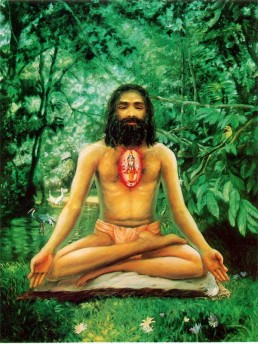
Sri Krishna now gives a complete and exhaustive explanation of the technique of meditation. The seat for practice of meditation should be in a clean place. The external conditions have a direct bearing on the human mind. The chances for the seeker to maintain a pure mental condition are more in a clean place. A tidy atmosphere causes the least mental disturbances.
The meditator should sit steady (sthiram) in his seat without moving his body in any direction since physical movements destroy the mental concentration and inner equipoise. In order to get established in a firm posture, it would be advisable to sit in any comfortable seat with the vertebral column erect, fingers interlocked and hands thrown in front.
The seat of meditation should not be too high or too low. Too high a seat causes a sense of insecurity and a seat too low may cause bodily pains. During meditation the heart becomes slightly slow causing even a slight fall in blood pressure and to that extent one gets withdrawn in himself. At such a time of low resistance, the position of the seat plays a vital part.
The mattress of Kusa Grass on the ground covered by a deer skin and a piece of cloth on top of it protects one from dampness, cold and heat.
Sitting properly by itself is not Yoga. While proper physical condition is necessary for inducing right mental attitude for spiritual practices, by itself it cannot assure any spiritual self development. Hence Sri Krishna tells here what a seeker should do in the seat of meditation having brought his body in a steady condition and how his mind and intellect should be kept engaged.
These instructions of The Lord are: One should make the mind single pointed by subduing the faculty of imagination and activities of the sense organs. Although single pointedness is the nature of the mind, by virtue of its capacity for imagination or wishful thinking and on account of the pulls and pressures of the external sense objects on the sense organs, it gets wild and scattered. The Lord says that if these two sources of dissipation are closed, the mind will get automatically single pointed. Keeping the mind contemplating on the Ultimate Self constantly is the inner Yoga suggested here.
The effect of such meditation is inner purification. A purified mind is the one wherein there are no agitations and when the mind becomes thus steady and pure, it discovers its own Real Nature just like one understands himself by looking at his own image in a mirror. The purification of the heart, chittasuddhi, is a matter of discipline. It is a
disciplined disinterestedness. Blessed are the pure in heart for they shall see God. Wisdom is a condition in a being at rest.