Commentary
The word Prashaanta means inward peace. This is the inner joy in which the meditator will find himself as a result of regular practice. Fear is the quality in a person who cannot believe that there is something beyond himself which is the Supreme.
The very process of turning towards the Supreme makes him afraid of nothingness. The seeker should therefore be fearless since it is the deadliest enemy for spiritual progress.
Even after the mind becomes peaceful and joyous and fearlessness achieved after a continuous practice of meditation and study of scriptures, no progress towards the goal can be possible unless the seeker gets established himself in perfect Brahmacharya. Brahmacharya implies the observance of celibacy as well as the practice of self control in all fields of sense-stimulations and sense-gratifications.
Without self control the mind will become chaotic due to the pressures of the world of objects. Unless the mind is provided with another target to concentrate upon it cannot
retreat from its usual pre-occupations with the external world. This alternative is the inner field of the Self.
When the body, mind and intellect are controlled through the above process, the seeker gains mental energy and experiences an increasing capacity to withdraw within himself and fix all his thoughts on `Me’, the Self. After taming the mind and stopping it from its external wanderings, it should be kept focused upon the Divine seeking nothing but the Supreme. The mind becomes still but not vacant for it is fixed on the Supreme. Ishvara Pranidhana is a recognized way in yoga discipline. They act in the world but the passionless tranquility of the spirit remains undisturbed. They are like lotus in the lake which is unruffled by the tide.
Swami Chinmayananda Commentary
The commentary on this verse and the rest, is avaialble for free as:
Kindle eBook
Google Play Book
Apple Books
Adi Sankara Commentary
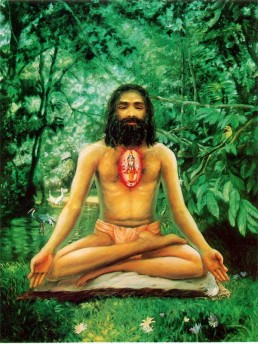
Dharayan, holding; kaya-siro-girvam, the body (torso), head and neck; samam, erect; and acalam, still-movement is possible for one (even while) holding these erect; therefore it is specified, ‘still’-; sthirah, being steady, i. e. remaining steady; sampreksya, looking svam nasikagram, at tip of his own nose -looking at it intently, as it were; ca, and; anavalokayan, not looking; disah, around, i. e. not glancing now and then in various directions-. The words ‘as it were’ are to be understood because what is intended here is not an injunction for looking at the tip of one’s own nose! What then? It is the fixing the gaze of the eyes by withdrawing it from external objects; and that is enjoined with a veiw to concentrating the mind. [What is sought to be presented here as the primary objective is the concentration of mind. If the gaze be directed outward, then it will result in interrupting that concentration. Therefore the purpose is to first fix the gaze of the eyes within.] If the intention were merely the looking at the tip of the nose, then the mind would remain fixed there itself, not on the Self! In, ‘Making the mind fixed in the Self’ (25), the Lord will speak of concentrating the mind verily on the Self. Therefore, owing to the missing word iva (as it were), it is merely the withdrawl of the gaze that is implied by sampreksya (looking). Further, prasantatma, with a placid mind, with a mind completely at peace; vigata-bhih, free from fear sthitah, firm; brahmacari-vrate, in the vow of a celibate, the vow cosisting in serivce of the teacher, eating food got by beggin, etc.-firm in that, i. e. he should follow these; besides, mat-cittah, with the mind fixed on Me who am the supreme God; samyamya, by controlling; manah, the mind, i. e. by stopping the modifications of the mind; yuktah, through concentration, i. e. by becoming concentrated; asita, he should remain seated; matparah, with Me as the supreme Goal. Some passionate person may have his mind on a woman, but he does not accept the woman as his supreme Goal. What then? He accepts the king or Sive as his goal. But this one (the yogi) not only has his mind on Me but has Me as his Goal. After that, now is being stated the result of Yoga:

The Bhagavad Gita with the commentary of Sri Sankaracharya – Translated by Alladi Mahadeva Sastry
Holy Geeta – Commentary by Swami Chinmayananda
The Bhagavad Gita by Eknath Easwaran – Best selling translation of the Bhagavad Gita
The Bhagavad Gita – Translation and Commentary by Swami Sivananda
Bhagavad Gita – Translation and Commentary by Bhaktivedanta Swami Prabupadha
Srimad Bhagavad Gita Chapter 6 – Verse 14 – 6.14 prasantatma vigatabhir – All Bhagavad Gita (Geeta) Verses in Sanskrit, English, Transliteration, Word Meaning, Translation, Audio, Shankara Bhashya, Adi Sankaracharya Commentary and Links to Videos by Swami Chinmayananda and others – 14-Jun