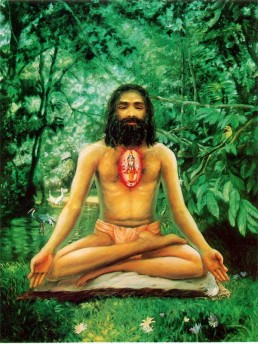
Moderation but not complete self-denial in all activities of life like eating, recreation, sleep and exertion in working is the basic principle stated here. The important guideline in this verse is that the amount of effort put in for all work, including selfless divine work, should be moderate as otherwise such work instead of redeeming the seeker would enslave him. What is required is restraint but not abstinence. Yoga should be practiced because it is capable of destroying all miseries.
Concepts and Issues
In this Chapter, Sri Krishna clears the doubt of Arjuna as to whether a Yogi and a Sanyasi are one and the same. The Lord says that everyone who wishes to become a Yogi or Sanyasi must perform his bounden duty. By performing one’s duty without expectation of results one becomes a Yogi. By renouncing all worldly thoughts, by constantly remembering God, through study of scriptures, Japa, Kirtan and Meditation one becomes a Sanyasi.
He who controls his body, mind and senses can remain calm in pleasure and pain, heat and cold, honor and dishonor. For him there is no friend or enemy and he feels no difference between gold and stone. He is a perfected Yogi. He sees God in everything. Such a sage who is self-controlled and free from all desires constantly engages his mind in meditation.
Sri Krishna describes the pre-requisites for meditation and explains to Arjuna the method of its practice. After observing all the preliminaries, with serenity of mind, fearlessness and vow of continence, the meditator should think of The Lord’s presence between the two eye-brows which is the point of concentration. Such a person will attain supreme peace or liberation.
The Lord advises that an aspirant should adopt moderation in all his daily activities like food, sleep and waking hours, yogic breathing and exercises, satsangs and svadhyaya etc.
Live as the Gita Teaches You to Live
Raise yourself by yourself.
Know what meditation is and practice it regularly.
Be moderate in everything you do.
Points to Ponder
How one can keep his mind steady?
What are the pre-requisites for meditation?
How one’s own self is his own friend and enemy?
Write short notes on the greatest among all types of Yogis.