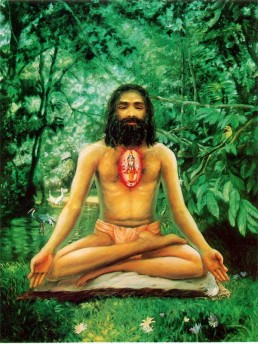
All these four Verses (20 – 23) should be taken together which give a complete picture of Yoga and explain the stages that a Yogi passes through whose mind has become single pointed by meditation. They end with a call given by The Lord to all mankind to practice this Yoga of Meditation and self development.
The goal of the meditator is attaining serene quietitude when his mind becomes completely restrained and gains an experience of the Self, not as an entity separate from himself but as his own true nature. This self discovery of the mind is nothing other than the process by which ego’s identification with body, mind and intellect is replaced by the principle of Divine Consciousness. The experience of the self is an enduring state from which there is no return.
Sri Krishna says that having gained this Infinite Bliss, no one can come to the worldly sorrows and feel the urge to go after the worldly objects and pursuits. The Yogi who attained the state of Supreme Truth will consider no other gain as equal to it and worth comparable. Thus Sri Krishna defines Yoga as a state of ‘DISUNION FROM EVERY UNION WITH PAIN’.
The term yoga means contact. Man is always in contact with finite worldly objects through the instruments of body, mind and intellect and gets finite joy only. When this temporary joy ends on account of the cessation of the instrumentality of the senses, sorrow begins. Therefore it is said that life through these matter instruments is called the life of union-with-pain.
Detachment from this union is the process in which we disassociate ourselves from the fields of objects and their experiences. As mind cannot exist without any attachment, once it is detached from the unreal and pain giving world of objects, it has to get itself attached to the Real and Permanent Bliss, which is called meditation. In deep meditation, the senses do not function; they are resolved into their cause i.e. the mind. And when the mind becomes steady and cognition alone functions, then the indescribable Self is realized.
Thus Yoga is nothing but a man’s renunciation of contacts with sorrows and turning towards Bliss which is his real nature. Sri Krishna says that this Yoga is to be practiced with an eager and decisive mind. Success in meditation is possible only when it is carried out with firm conviction, perseverance and an un-despairing heart as the Yoga or connection with the Real can be gained only with Viyoga or disconnection from the Unreal. There should be no relaxation of effort even though there is no quick result and the practice appears difficult. If living among the finite objects with its limited joys is sorrow, then to get away from it all is to enter the realm of Bliss which is the Self. This is Yoga.
Patanjali Yoga Sutras declare that the root of sorrow in the form of repeated births and deaths lies in the contact between the subject and the object or in the liaison due to ignorance between the soul and the objective world. With the termination of this contact, sorrows and sufferings also come to an end for all time.
Patanjali says ‘The great sorrow in the form of future births and deaths is called ‘Heya’- that which ought to be avoided (2.16). The cause of ‘Heya’ or suffering is the contact between the subject and the object (2.17). Ignorance is the root of that contact (2.24). The termination of that contact between the subject and the object through the eradication of the ignorance is known as ‘Hana’ – shutting out the ‘Heya’. This represents the aloofness of the subject – Kaivalya (2.25)
This state of God realization is termed ‘Yoga’ in the Gita. Further instructions on yoga are continued in the following verses.