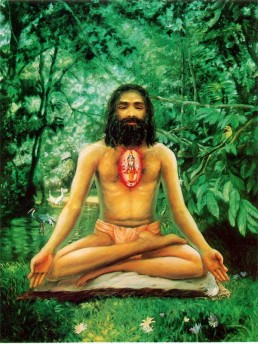
Hi, verily; yada, when; a yogi who is concentrating his mind, sarva-sankalpa-sannyasi, who has given up thought about everything-who is apt to give up (sannyasa) all (sarva) thoughts (sankalpa) which are the causes of desire, for things here and hereafter; na anusajjate, does not become attached, i. e. does not hold the idea that they have to be done by him; indriya-arthesu, with regard to sense-objects like sound etc.; and karmasu, with regard to actions-nitya, naimittika, kamya and nisiddha (prohibited) because of the absence of the idea of their utility; tada, then, at that time; ucyate, he is said to be; yoga-arudhah, established in Yoga, i. e. he is said to have attained to Yoga. From the expression, ‘one who has given up thought about eveything’, it follows that one has to renounce all desires and all actions, for all desires have thoughts as their source. This accords with such Smrti texts as:’Verily, desire has thought as its source. Sacrifices arise from thoughts’ (Ma. Sm. 2.3);’O Desire, I know your source. You surely spring from thought. I shall not think of you. So you will not arise in me’ (Mbh. Sa. 177.25). And when one gives up all desires, renunciation of all actions becomes accomplished. This agrees with such Upanisadic texts as, ‘(This self is identified with desire alone.) What it desires, it resolves; what it resolves, it works out’ (Br. 4.4.5); and also such Smrti texts as, ‘Whatever actions a man does, all that is the effect of desire itself’ (Ma. Sm. 2.4). It accords with reason also. For, when all thoughts are renounced, no one can even move a little. So, by the expression, ‘one who has given up thought about everything’, the Lord makes one renounced all desires and all actions. When one is thus established in Yoga, then by that very fact one’s self becomes uplifted by oneself from the worldly state which is replete with evils. Hence,