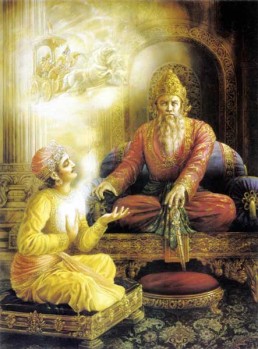
In the entire Gita this is the only uttering of the blind king, Dhritarashtra. All the remaining verses are Sanjaya`s report to him about the happenings at the battlefield of Kurukshetra just before the war.
The battlefield is called dharmakshetra or the sacred field because The Lord who is the protector and embodiment of Dharma was actively present in it. Kurukshetra means the field of the Kurus, a leading clan of that era. This question of Dhritarashtra exhibits a sense of anxiety in him on two counts. If Pandavas decide not to undertake the war, his sons will automatically get the kingdom and in such an event, the stigma of waging the unrighteous war might not stick to his covetous and deceitful sons. If his sons decide not to wage the war they will lose the kingdom that was earlier acquired by them through deceit, because of which they will be as good as dead. Such was the anxiety in the king’s mind because of the greatness and spiritual atmosphere of the field of battle.
Mamakaah : My people. And ‘Pandu’s sons’. – This sort of divisive reference to one and the same family members indicates the absence of the sense of familiarity and closeness with regard to the Pandavas and thereby betrays hostility towards them.
This sense of a pair of opposites ‘mine-ness’ and ‘not mine-ness’ is the result of ahamkara or `I – ness’ which is the source of all evil. The conflict between the two cousin groups represents the clash between two sets of values of life – one standing for virtue, justice and righteousness staking a legitimate claim for the kingdom lost through deceit and treachery and the other for vice, injustice, greed, hunger for power and the foul means employed to justify the ends. It indirectly indicates that life itself is a battle between good and evil.
TWO ARMIES