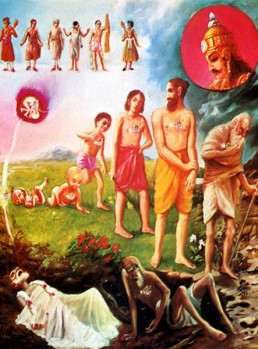
There are four propositions in this verse. 1.Arjuna is grieving 2. He is grieving for those not to be grieved for. 3. He speaks the words of the wise though he is not so, and 4. The wise do not grieve for the living or for the dead.
Let us have a closer look at these statements.
The cause for Arjuna’s suffering and distress is because when he looked at his relatives, friends and teachers lined up on the opposite side, the feeling of ‘me’ and ‘mine’ became very strong in him, the central point being the sense of ‘I.’ A man is grieved when he categorizes some objects or persons as his own and some others as not his own. This sense of mine and not-mine – attachment for things considered as one’s own and indifference for things considered as not one’s own – is called ego which is the source of all grief, worry, fear and confusion. Rediscovering oneself to be really higher than one’s ego is the end of all sorrows arising out of false identification or relationship.
So Krishna went to the bottom of this grief, sorrow, misery and suffering and explained that a wise man does not have the sense of ‘I’, ‘me’ and ‘mine’. Such a man is not bound by any tie or attachment of any kind.
Here the phrase ‘those not to be grieved for’ refers to Bhishma and Drona. Why they are not to be grieved for? It is because they are beyond the sense of attachment and the feeling of ‘I’ ‘my’ and ‘mine’. That is the reason why they are on the side of the Kaurava army despite the Pandavas being equally dear to them. They are aware of the difference between the real and the unreal, the soul and the body respectively. They are wise because they have realized the eternal reality behind the phenomenal changes and therefore do not grieve at the decay and death of the finite and the mortal in the form of the physical bodies.
When we go to the sea shore we do not grieve over each wave that rises and dissolves for we know that they are unreal and the real thing is the water in the waves. Waves are like the physical bodies which appear and disappear while the indweller of the body, the self or soul is like the water. Those who have realized this eternal truth have no sorrow for the change they perceive in the world of happenings.
Thus both real and unreal are not to be grieved at as the real is imperishable and therefore should not be grieved for. The unreal is bound to perish, as it is perishing at every moment, so it should not also be grieved at. It follows that Arjuna’s grief over the bodies of his relatives getting perished is misplaced and is the consequence of his ignorance, lack of right knowledge, avidya although his words apparently look wise which in fact they are not. Hence Krishna says that he is grieving for those who should not be grieved for.
What Krishna means is ‘Arjuna, Look at those standing before you not as human beings; look at them as the souls (atman) and the soul is immortal; you cannot kill the soul if you have the real knowledge’. The idea is, ‘You are sorrowing for those who are eternal in the real sense, and therefore who are not to be grieved for. Hence you are a fool’.
‘The wise do not mourn for the dead or for the living,’ says Krishna to Arjuna. Why? Because there are no ‘living’ or ‘dead’ in the sense that those with bodies are alive and those divested of a body are dead. Nor is there such a duality called life and death. These are only the illusions produced by the distorting veils of ignorance. ‘Lead me from death to immortality’ is not a petition to gain a state where we will nevermore experience
bodily death, but a plea to be led from the outward-turned consciousness that produces death to the inward-turned consciousness that produces life. It is spirit itself that is immortality’nothing else.
In order to remedy this myopic view of Arjuna, Krishna administered the strongest medicine of the Knowledge of the Self to him at the very first stroke from the 11th verse of this chapter which is considered as the key verse of the Gita. All the subsequent teachings are an elaboration of the principle laid down in this verse.
He advised Arjuna to renounce his physical, emotional and intellectual estimate of his grand-sire and teacher and to re-evaluate the situation from his spiritual understanding whereby his problem at the battlefield would vanish.