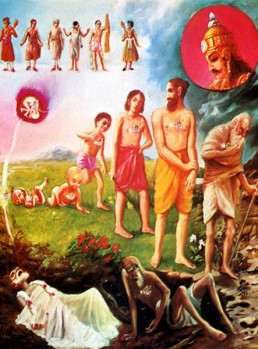
Commentary
Objects are perceived not by the sense organs viz. skin, ear, eye, nose and tongue but through them. The sense organs are the channels through which the perceiving-ego gathers the knowledge of the objects such as touch, sound, form, smell and taste. If this process of perceiver contacting the objects through sense organs does not take place the objects as such can not bring any response or reaction in any individual.
The object remaining the same it can give different experiences to the same individual at different times or at the same time to different individuals. Cold is pleasant at one time and unpleasant at another. Heat is pleasant in winter and not in summer. Food is welcome to a hungry person but not to the one who just finished his lunch. So the sense contacts that give rise to feelings of heat and cold, pleasure and pain, favorable and unfavorable experiences come and go. They are therefore impermanent in nature, giving pleasure at one moment and pain at another. One should bear all the pairs of opposites patiently and thus develop a balanced state of mind. Do not give yourself to joy or grief on their account.
Joys and sorrows are all responses of the mind to the conducive and non-conducive world around us. They are but mental reactions – thoughts. Learn to be observer of these emotions rather than get identified with them. Do not react but reflect. Stand apart – be aloof in yourself – be just an uninterested witness to the tumults of the mind. This attitude gives poise and balance.
The pairs of opposites like heat and cold are impermanent as distinguished from the Permanent Self, the Indweller. Actually there is no affinity between the Self and the unreal pairs of opposites. But it assumed this affinity which can be rooted out only when we cease to accept it. A woman bereaved of her husband say fifty years ago, and if anyone called her as the wife of her husband Mr. so and so she becomes alert and feels sad even today. It shows that the assumed affinity has not yet broken off which means
that though the objects are lost, yet the assumed affinity persists which continues to cause anguish. The more one is able to distance oneself with this assumed affinity and identifies himself with the permanent Self, the less one is affected by the agreeable and disagreeable conditions of life.
Mere knowledge of agreeable and disagreeable senses is not bad. But attachment with and aversion to them is a fault. Not to be affected by such an evil is expressed by the term ‘endure them’. Moreover, body, the sense organs and their actions have a beginning and an end. But the perceiver, the ‘I’ never changes and therefore we should remain unaffected by such transitory and fleeting experiences which is called ‘endurance’.
WHAT GOOD COMES TO HIM WHO ENDURES THESE DESIRABLE AND UNDESIRABLE SITUATIONS?
Swami Chinmayananda
Swami Chinmayananda Commentary
The commentary on this verse and the rest, is avaialble for free as:
Kindle eBook
Google Play Book
Apple Books
Adi Sankara Commentary
‘In the case of a man who knows that the Self is eternal, although there is no possibility of delusion concerning the destruction of the Self, still delusion, as of ordinary people, caused by the experience of cold, heat, happiness and sorrow is noticed in him. Delusion arises from being deprived of happiness, and sorrow arises from contact with pain etc.’ apprehending this kind of a talk from Arjuna, the Lord said, ‘But the contacts of the organs,’ etc.
Matra-sparsah, the contacts of the organs with objects; are sita-usna-sukha-duhkha-dah, producers of cold, heat, happiness and sorrow. Matrah means those by which are marked off (measured up) sounds etc., i. e. the organs of hearing etc. The sparsah, contacts, of the organs with sound etc. are matra-sparsah. Or, sparsah means those which are contacted, i. e. objects, viz sound etc. Matra-sparsah, the organs and objects, are the producers of cold, heat, happiness and sorrow.
Cold sometimes produces pleasure, and sometimes pain. Similarly the nature of heat, too, is unpredictable. On the other hand, happiness and sorrow have definite natures since they do not change. Hence they are mentioned separately from cold and heat. Since they, the organs, the contacts, etc., agamapayinah, have a beginning and an end, are by nature subject to origination and destruction; therefore, they are anityah, transient. Hence, titiksasva, bear; tan, them-cold, heart, etc., i. e. do not be happy or sorry with regard to them.
The Bhagavad Gita with the commentary of Sri Sankaracharya – Translated by Alladi Mahadeva Sastry
Holy Geeta – Commentary by Swami Chinmayananda
The Bhagavad Gita by Eknath Easwaran – Best selling translation of the Bhagavad Gita
The Bhagavad Gita – Translation and Commentary by Swami Sivananda
Bhagavad Gita – Translation and Commentary by Bhaktivedanta Swami Prabupadha
Srimad Bhagavad Gita Chapter 2 – Verse 14 – 2.14 matra-sparshas – All Bhagavad Gita (Geeta) Verses in Sanskrit, English, Transliteration, Word Meaning, Translation, Audio, Shankara Bhashya, Adi Sankaracharya Commentary and Links to Videos by Swami Chinmayananda and others – 14-Feb