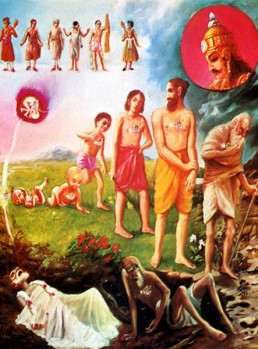
Commentary
Titiksha or the power of endurance of the pairs of opposites advocated here does not mean a meek submission to sorrows in life (Stoic philosophy) but signifies the equipoise of mind in both pleasure and pain entertained by a wise man based on the knowledge of the Soul’s immortality.
Endurance, coupled with the discrimination between the real and the unreal and detachment from the worldly objects and pleasures, prepares the aspirant for right knowledge, which alone leads to liberation.
Vedanta defines endurance as the bearing of all afflictions without wishing to redress them, while being free from all anxiety or regret on their account.
This perfect sameness or equanimity amidst the ills of life means full and unbroken consciousness of our oneness with the immortal Self. At that stage a person becomes fit for attaining immortality or knowledge of Self – the ultimate goal of life. Immortality means the infinite experience of the Eternal and the Permanent. Eternal life does not mean survival of death, but it is the transcendence of life and death.
HOW THE SOUL IS ETERNAL AND HOW THE CONTACTS WITH SENSORY OBJECTS ARE TRANSITORY? THE DISTINCTION BETWEEN THE REAL AND THE UNREAL. ADDITIONAL EXPLANATIONS.
Swami Chinmayananda
Swami Chinmayananda Commentary
The commentary on this verse and the rest, is avaialble for free as:
Kindle eBook
Google Play Book
Apple Books
Adi Sankara Commentary
What will happen to one who bears cold and heat? Listen: Verily, the person….,’etc.
(O Arjuna) hi, verily; yam purusam, the person whom; ete, these, cold and heat mentioned above; na, do not; vyathayanti, torment, do not perturb; dhiram, the wise man; sama-duhkha-sukham, to whom sorrow and happiness are the same, who is free from happiness and sorrow when subjected to pleasure and pain, because of his realization of the enternal Self; sah, he, who is established in the realization of the enternal Self, who forbears the opposites; kalpate, becomes fit; amrtattvaya, for Immortality, for the state of Immortality, i. e. for Liberation.
The Bhagavad Gita with the commentary of Sri Sankaracharya – Translated by Alladi Mahadeva Sastry
Holy Geeta – Commentary by Swami Chinmayananda
The Bhagavad Gita by Eknath Easwaran – Best selling translation of the Bhagavad Gita
The Bhagavad Gita – Translation and Commentary by Swami Sivananda
Bhagavad Gita – Translation and Commentary by Bhaktivedanta Swami Prabupadha
Srimad Bhagavad Gita Chapter 2 – Verse 15 – 2.15 yam hi na vyathayantyete – All Bhagavad Gita (Geeta) Verses in Sanskrit, English, Transliteration, Word Meaning, Translation, Audio, Shankara Bhashya, Adi Sankaracharya Commentary and Links to Videos by Swami Chinmayananda and others – 15-Feb