Commentary
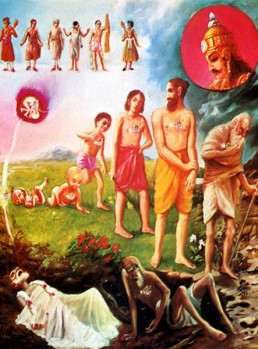
Sri Krishna, for the sake of argument, takes up the popular assumption here. Granting that the Self is again and again born whenever a body comes into being and again and again dies whenever the body dies, even then one should not grieve, because birth is inevitable to that which dies and death is inevitable to that which is born. This is the inexorable law of the nature. As such, the occasion that Arjuna faces is not the one for lament.
Swami Chinmayananda Commentary
The commentary on this verse and the rest, is avaialble for free as:
Kindle eBook
Google Play Book
Apple Books
Adi Sankara Commentary
This (verse), ‘On the other hand,’ etc., is uttered assuming that the Self is transient. Atha ca, on the other hand, if (-conveys the sense of assumption-); following ordinary experience, manyase, you think; enam, this One, the Self under discussion; is nityajatam, born continually, becomes born with the birth of each of the numerous bodies; va, or; nityam, constantly; mrtam, dies, along with the death of each of these (bodies); tatha api, even then, even if the Self be of that nature; tvam, you; maha-baho, O mighty-armed one; na arhasi, ought not; socitum, to grieve; evam, thus, since that which is subject to birth will die, and that which is subject to death will be born; these two are inevitable.
The Bhagavad Gita with the commentary of Sri Sankaracharya – Translated by Alladi Mahadeva Sastry
Holy Geeta – Commentary by Swami Chinmayananda
The Bhagavad Gita by Eknath Easwaran – Best selling translation of the Bhagavad Gita
The Bhagavad Gita – Translation and Commentary by Swami Sivananda
Bhagavad Gita – Translation and Commentary by Bhaktivedanta Swami Prabupadha
Srimad Bhagavad Gita Chapter 2 – Verse 26 – 2.26 atha chainam – All Bhagavad Gita (Geeta) Verses in Sanskrit, English, Transliteration, Word Meaning, Translation, Audio, Shankara Bhashya, Adi Sankaracharya Commentary and Links to Videos by Swami Chinmayananda and others – 26-Feb