Commentary
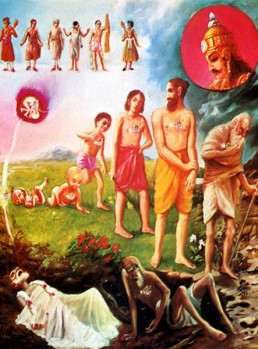
The world of beings which we see and experience i.e. the world which is manifest follows the law of causation. Effects rise from the causes. The effects are manifest i.e. visible while the causes are unmanifest. Projection from the unmanifest to the manifest is called the creation of a thing.
The manifest world of today was in a condition of unmanifest before its creation. Now temporarily it is manifest or available for cognition. It shall fade away one day again into unmanifest. The present came from the unknown and will return to the unknown. The physical body is a combination of the five elements. It is perceived by the physical eye only after the five elements have entered into such combination. After death the body disintegrates and the five elements return to their source. The body cannot be perceived then. Therefore the body can be perceived only in the middle state.
Thus before birth, beings had no connection with the bodies; after death too they would maintain no connection with these gross bodies. During the intermediate period alone viz. from birth to death, they are manifest and maintain relationship with their bodies.
The relationships such as son, wife, father, mother, brother, sister and teacher etc., are formed through the body because of delusion and attachment. Such relationships are only temporary as long as the bodies can perceive and are mere correlations as causes and effects just as we perceive the dream world only as long as the dream lasts and which was not existent before or after the dream.
It is just like a pot which was not there before it was made nor would it be there when it is destroyed. The only constant factor was the mud out of which the pot was made. The existence of the pot is visible only in the middle state and hence its existence is illusory. So also there is no body in the beginning or in the end. That which does not exist in the beginning or in the end must be having no real existence in the middle state as well. It can only be an illusory perception. He who thus understands the nature of the body and
all human relationships based upon it will not allow them to have any influence upon his mind and therefore there is no point in lamenting over the situation.
MARVELOUS NATURE OF THE SOUL
Swami Chinmayananda Commentary
The commentary on this verse and the rest, is avaialble for free as:
Kindle eBook
Google Play Book
Apple Books
Adi Sankara Commentary
It is not reasonable to grieve even for beings which are constituted by bodies and organs, since ‘all beings remain unmanifest’ etc. (Bharata, O descendant of Bharata;) bhutani, all beings, avyaktaduni, remain unmainfest in the beginning. Those beings, viz sons, friends, and others, constituted by bodies and organs, [Another reading is karya-karana-sanghata, aggregates formed by material elements acting as causes and effects.-Tr.] who before their origination have unmanifestedness (avyakta), invisibility, nonperception, as their beginning (adi) are avyaktaadini. Ca, and; after origination, before death, they become vyakta-madhyani, manifest in the middle. Again, they eva, certainly; become avyakta-nidhanani, unmanifest after death. Those which have unmanifestness (avyakta), invisibility, as their death (nidhana) are avyakta-nidhanani. The idea is that even after death they verily attain unmanifestedness. Accordingly has it been said: ‘They emerged from invisibility, and have gone back to invisibility. They are not yours, nor are you theirs. What is this fruitless lamentation!’ (Mbh. St. 2.13). Ka, what; paridevana, lamentation, or what prattle, can there be; tatra, with regard to them, i. e. with regard to beings which are objects of delusion, which are invisible, (become) visible, (and then) get destroyed!

The Bhagavad Gita with the commentary of Sri Sankaracharya – Translated by Alladi Mahadeva Sastry
Holy Geeta – Commentary by Swami Chinmayananda
The Bhagavad Gita by Eknath Easwaran – Best selling translation of the Bhagavad Gita
The Bhagavad Gita – Translation and Commentary by Swami Sivananda
Bhagavad Gita – Translation and Commentary by Bhaktivedanta Swami Prabupadha
Srimad Bhagavad Gita Chapter 2 – Verse 28 – 2.28 avyaktadini – All Bhagavad Gita (Geeta) Verses in Sanskrit, English, Transliteration, Word Meaning, Translation, Audio, Shankara Bhashya, Adi Sankaracharya Commentary and Links to Videos by Swami Chinmayananda and others – 28-Feb