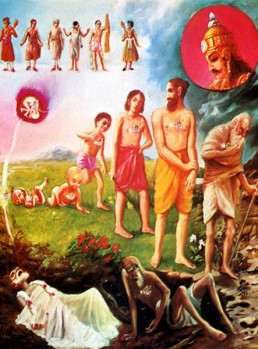
Arjuna wondered as to how he was being asked to fight Bhishma and Drona, who were not his enemies but respected elders and teachers worthy of worship. When even using soft words against them was considered sin, Arjuna was surprised about his being exhorted to wage war against them with arrows.
Arjuna continued that it would be better for him to eat food by begging, which was most unbecoming for a man of warrior class, than to slay his noble elders on the Kaurava side. He felt that even if they were killed, his subsequent enjoyment would be stained with their blood and therefore not worth anything and the life in this world would be nothing but hell.
A question arises, why is it that Bhishma and Drona, who are not his enemies, are on the side of Duryodhana? They are there because as Arjuna says Bhishma and Drona are ‘arthakaman’, which means even though they never approved the criminal ways of Duryodhana, they still sought, accepted and enjoyed the royal hospitality of Duryodhana for so long that they now feel obligated to him so much that they simply cannot abandon Duryodhana in his time of need. That is how Bhishma and Drona are now caught on the side of Duryodhana. Arjuna feels that it is their problem and he has nothing to do with it and so he sticks to his point of view that they are worthy of his worship.
He had also said that Duryodhana and his companions being goaded by greed were prepared to wage war; but for himself if he wages war, he will enjoy only blood-stained pleasure in the form of wealth and sensual enjoyment. Thus he perceives nothing but evil in waging war.
When an evil comes to us in the form of an evil, it is easier to do away with it, than when it comes in the garb of something good. Ravana could not be recognized by Sita because he disguised himself as a sage while Krishna killed Kamsa and others recognizing them as evil forces. Similarly Arjuna perceives that it is virtuous not to wage war and it is an evil to wage war. Hence Krishna had to give an elaborate explanation to convince Arjuna about the real wisdom.
When sentiment overtook and clouded his understanding Arjuna lost the faculty of judgment and started doubting as to who should conquer whom?
Realizing his complete helplessness in knowing the nature of his duty and admitting his incapacity to face the crisis and the challenges presented before him, he surrendered himself to Sri Krishna. He confessed before The Lord that he was his disciple and requested Him to tell him for certain what was good for him.
Arjuna does not ask for a metaphysic as he is not a seeker of knowledge; as a man of action he asks for the law of action, for his dharma, for what he has to do in this difficulty. ‘Master, what would you have me to do?’ that is his question.
Arjuna made it clear that in spite of the victory in the war which will in any case bring him an affluent kingdom on this earth and lordship over the Gods, he could not see any way to drive away his grief which was eating away his vitals. He appealed to The Lord to show him a definite way which would remove his grief and guide him in his Dharma.