Sri Krishna says whatever be the strength of the negative forces they have already been destroyed by the all powerful `Time’ and Arjuna has only to act as an instrument in their ruin and claim victory to himself. In fact during all actions in our lives we are merely the instruments in the hands of The Lord. The concept of self surrender for serving the world in the constant awareness of The Lord is the only way for claiming glory in our lives. The God of destiny decides and ordains all things and Arjuna is to be the instrument, the flute under the fingers of the Omnipotent One who works out the mighty evolution. Arjuna is self-deceived if he believes that he should act according to his own imperfect judgment. No individual soul can encroach on the prerogative of God. In refusing to take up arms, Arjuna is guilty of such mischievous presumption.
The doctrine of Divine Predetermination is upheld here that indicates utter helplessness and insignificance of the individual and the futility of his will and efforts. The decision is made already and Arjuna can do nothing to change it. This however does not mean that the cosmic process is a mere unveiling of a ready made scenario. It only affirms the meaning of eternity in which all moments of the whole of time, past, present and future, are contemporary to the Divine Spirit. Each moment of evolution in time has no novelty in it nor does it project any inconsistency in the Divine Eternity.
The ideas of God are worked out through human instrumentality. Nothing exists save the Lord’s will. He alone is the doer and we are only the instruments. Judged from the human standards the consequences of war are abhorrent and hence none should encourage it. But once the purpose of the Almighty behind the war is revealed Arjuna acquiesces in it. What he desires or what he gains do not count any more. Behind this world of space- time, inter-penetrating it, is the creative purpose of God. We must understand that Supreme Design and be content to serve it. The consciousness of the divine agency and its constant application in all works release man from responsibility.
Every act is a symbol of something beyond itself. Sri Krishna specifically mentioned the names of the four great warriors because they were considered invincible and even then they were eliminated by the Principle of Destruction and therefore He advises Arjuna not to be afraid of incurring sin by killing them and others though they are venerable to him.
When Krishna tells Arjuna that he will conquer his enemies in the battle we have to understand it as the divine will and that Arjuna is not permitted to take credit for his victory.
Concepts and Issues
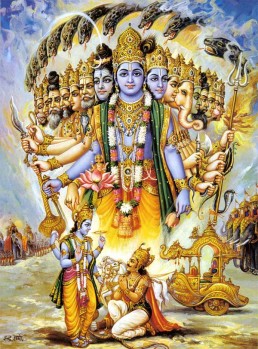
After hearing the secret of divine manifestation and its glory Arjuna says his delusion has gone and expresses his eagerness to see the Lord’s Cosmic Form. As the Cosmic Form cannot be seen by the ordinary physical eyes Sri Krishna bestows Arjuna with Divine Vision to enable him to see such form.
Sanjaya who was witnessing everything happening in the battlefield describes to Dhritarashtra the Cosmic Form of the Lord as seen by Arjuna.
It is an extraordinary form with myriads of faces, ornaments and weapons. Decorated with divine garlands and garments, the wondrous cosmic form is more brilliant than a million suns. The whole world of variegated forms constitutes only a small part of his being.
Excited by wonder and joy, Arjuna starts praying to that Divinity. This beautiful hymn of 17 verses gives nice description of the Cosmic Form. All beings- divine, human and subhuman- are being seen in Him. He has several arms, stomachs and faces. He is extraordinarily brilliant. He has pervaded the whole space. All beings like gods and sages, are praising Him with folded hands. The various heroes arrayed on the battlefield are entering into Him and getting destroyed like moths in the fire. Gripped with fear and wonder, Arjuna prays to Him to reveal who He is.
The Lord replies that He is Time, the eternal destroyer. He has come to annihilate the warriors in the enemy armies. Since this task will be achieved by Him even without Arjuna’s involvement, the Lord advises Arjuna to fight merely as an instrument and get victory, fame and kingdom.
The underlying concept behind this Chapter is that Brahman is the substratum behind the phenomenal universe and that every thing therein moves according to the Divine Law irrespective of what man thinks or does.
Live as the Gita Teaches You to Live
The advice is surrender to the Allmighty and to do our duty as His chosen instruments without any egoism.
Points to Ponder
What is the significance of the Cosmic Form?
Elucidate the contrast between this Chapter and the previous one.
What is meant by acting as an instrument?
What is the requirement for seeing the Cosmic Form?