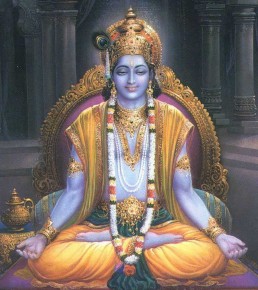
The process of meditation and attaining the Supreme – Brahman – is discussed. The prerequisites or the qualities which are necessary for meditation are as follows:
Pure intellect – An intellect without tendencies to acquire, possess and enjoy sense objects.
Controlling the mind and senses – By receiving the external stimuli the sense organs distract the mind from concentrating on the Infinite and hence they have to be controlled.
Renouncing sense objects – By controlling the sense organs the external stimuli such as sound, form, touch, taste or smell can be prevented from reaching the mind through the respective channels of ears, eyes, skin, tongue and nose. Once this is achieved sense objects automatically lose their value and attraction.
Abandoning attraction and hatred – When the mind is thus protected it cannot, by itself, get agitated by recapitulating agreeable or disagreeable incidents or things.
Thus a successful meditator is one who has an intellect purified from all extrovert desires, who has brought the mind and sense organs under the control of the intellect, thereby preventing them from running after sense objects and who has given up the ideas of likes and dislikes.
Dwelling in solitude – seeking a place where there will be least disturbance.
Eating but little – Temperate eating habits.
Subduing body, mind and speech – Elimination of egocentric attitude in all our thinking, action and relationship with others.
Ever engaged in meditation and concentration – After the mind is quietened it has to be kept continuously busy by contemplation on The Lord in an attitude of complete identification with Him.
Taking refuge in dispassion – It is a state where the mind finds no attraction for the objects of the senses. This attitude of dispassion or vairagya is necessary for the spiritual growth.
Thus a true seeker of a higher life must seek solitude, live in temperance, subdue his body, mind and speech and must live in a spirit of dispassion.
The qualities that are to be renounced for meditation are:
Although Sri Krishna lists out these qualities, they are in fact basically only one which is the sense of `I-ness’. When this sense of doership develops, egocentric vanity takes over the individual claiming a false sense of power, pride and arrogance. For an individual working under the influence of power and arrogance, lust and anger are natural while he tries by any means to acquire more and more wealth and protects what has already been acquired.
The Lord advises to abandon the following six qualities and thus become egoless and tranquil.
egoism
strength
arrogance
desire,
anger
covetousness
This is the peace arising out of wisdom and satisfaction experienced in the Realm of Perfection. When the sense of agency and the endless chase of sense gratifications have been renounced the seeker experiences a relative quietitude within him.
This verse does not say that such an individual has reached Perfection but it only says that he is worthy of becoming one with Brahman. Thus what has so far been discussed is only the preliminary preparation for the final Realization.
THE HIGHEST DEVOTION